

Concepts in Action: Practical Strategies for Early Years Classrooms
In everyday conversation, the word concept is not used very often. We usually mention it when referring to specific ideas, and we tend to assume that everyone shares the same understanding of what it means. According to the Cambridge Online Dictionary, a concept is a principle or idea. The Merriam-Webster Online Dictionary defines it as:
(1) something formed in the mind – a thought or notion, and (2) an abstract or general idea developed from specific examples. However, in the International Baccalaureate (IB) context, the meaning of concept goes beyond a simple idea or thought. It serves as a main element that helps structure understanding and connects learning across different subjects.
The IB defines concepts as organizing ideas that have relevance within and across subjects as well as across national and cultural boundaries. Concepts provide the language and the mental structure to foster ways of knowing and thinking across different subjects.
As an early years educator, it could be the best to interpret the meaning of concept as follows:
Concepts are big ideas that help children make sense of their learning. They connect different experiences and support children in thinking more deeply about the world around them. You may agree with this definition, or you may have your own understanding of what a concept means.
These are the seven specified concepts in the IB Primary Years Programme:
- Causation: Why is it like it is?
- Change: How is it transforming?
- Responsibility: What are our obligations?
- Connection: How does it link to other things?
- Form: What is it like?
- Function: How does it work?
- Perspective: What are the points of view?
Challenging yet engaging
Learning concepts is not always easy, especially for young children. As students grow older, they often have fewer chances to practice finding big ideas from real experiences and using them in new situations. Even though their brains are capable of this kind of thinking, it is not always the main focus in daily classroom learning. However, when children are given meaningful and real experiences to explore big ideas, they become more interested, engaged, and confident in their thinking.
First power tool: Students’ background knowledge
As a teacher, we will get the spot of attention if the students have ideas to share. By simply showing pictures, they start to share things for example. That’s an important tool for us.
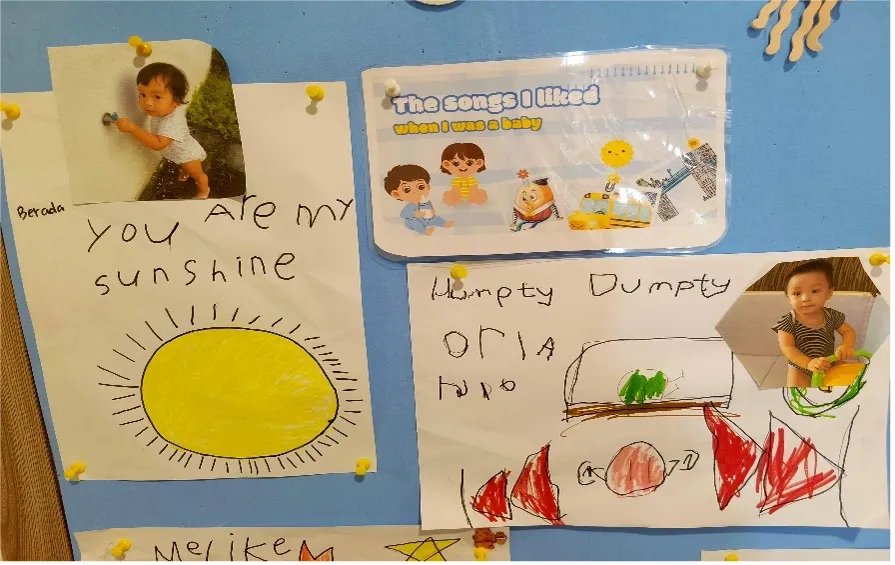
Students’ background knowledge is a powerful teaching tool. It allows teachers to anchor abstract concepts in familiar experiences, making big ideas easier for young learners to grasp. In our “How we express ourselves” unit of inquiry, we used songs that the children were familiar with and often listened to when they were babies. This simple connection sparked interactive discussions and helped them reflect on how their preferences have changed over time.
In our “How We Express Ourselves” unit of inquiry, we explored the specified concepts of change and perspective in a very personal and meaningful way. The students compared their favourite songs when they were babies with their favourite songs now.
My favourite song when I was a baby.
The objective is for the students to express their song through drawings.
The teachers put their photos when they were babies.
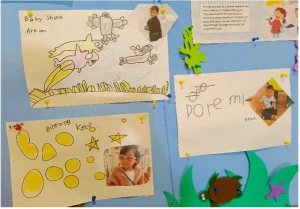
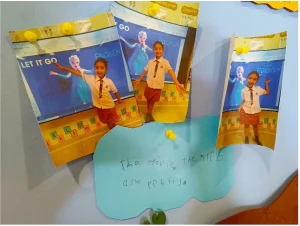
My favourite songs now
The objectives for the students are to:
- Create movements for their current favourite songs
- Perform in front of the class
- Write their thoughts about the songs
This meaningful learning engagement helped them understand that preferences can change over time. When they realised that they no longer enjoy the same songs they listened to as babies, they began to see that change happens naturally as they grow.
At the same time, the concept of perspective emerged. Each child had different favourite songs. Some liked energetic songs, while others preferred calm melodies. Through sharing and discussion, they began to understand that everyone has various tastes and that these differences are okay.
Even though the words “change” and “perspective” are abstract for preschoolers, the experience made the concepts concrete and relatable.
Reflection
Most of the students chose their current favourite songs based on movies they enjoy. However, one student introduced a song that was unfamiliar to both peers and teachers. As we listened together, the class responded with curiosity and attentiveness. This moment reflected the IB learner profile in action. The students demonstrated open-mindedness by respectfully listening to something new and different. They showed they were communicators as they asked questions and expressed their thoughts about the song. They also acted as thinkers by comparing it with their own song choices and considering why preferences may differ.
Connected to approaches to learning, this experience strengthened their communication skills through active listening and discussion. It also supported thinking skills, particularly comparing, reflecting, and making connections. Additionally, students practiced social skills by showing respect for different tastes and perspectives within the group.
Tips: How to Make Specified Concepts Familiar in Daily Teaching and Learning
Practical ideas like these can be done:
1. Use simple language repeatedly
Instead of formal definitions, use child-friendly language:
Change → “What is different now?”
Perspective → “Do you think the same or differently?”
Form → “What is it like?”
Function → “What does it do?”Repeat these questions naturally during play and discussions.
2. Connect concepts to daily routines
When plants grow → talk about change
When students disagree → talk about perspective
When building blocks fall → talk about function3. Encourage comparison
Comparison is powerful in early years:
Then and now
Big and small
My idea and your ideaThis helps children develop conceptual thinking gradually.
4. Use a reflection circle
At the end of learning engagements, ask simple questions:
“What changed?”
“Did anyone think differently?”
“What makes you say that?”So, while the word concept may simply mean an idea in daily language, in the IB it has a deeper meaning. A concept is a big idea that helps students connect their learning and understand things more deeply. It helps teachers move beyond teaching facts and instead guide students to think and make connections.
by:
Debby Selvianita
Early Years Co-Teacher
BINUS SCHOOL Surabaya
Related Posts
Empowering Every Learner: Personalised Learning at BINUS SCHOOL Surabaya
07 August, 2025

6 Practical Ways to Support Child’s Growth at Home
03 March, 2026

Wujudkan Asta Cita Presiden Prabowo, Binus School Surabaya Dukung Indonesia Maju
23 December, 2024


Your Comment