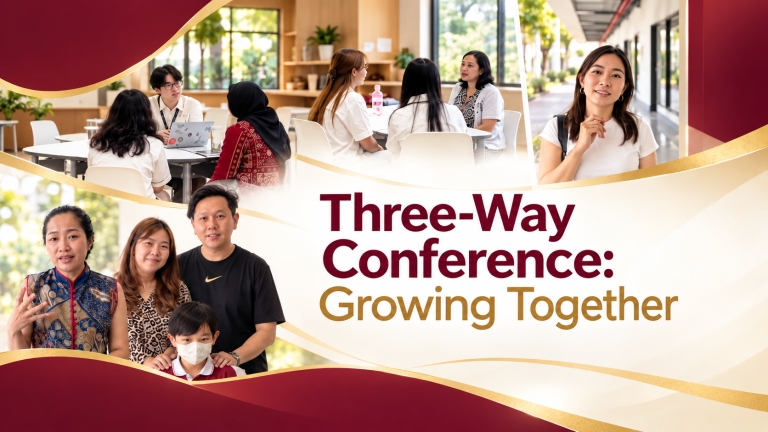
Things I love about BINUS SCHOOL is the open infrastructure building that makes my children feel comfortable. As a parent, I also see there are three things that I’ve seen progress in my children, Sadrach and Grecia since they studied at BINUS SCHOOL; self-leadership, self-discipline, and developing social skills.
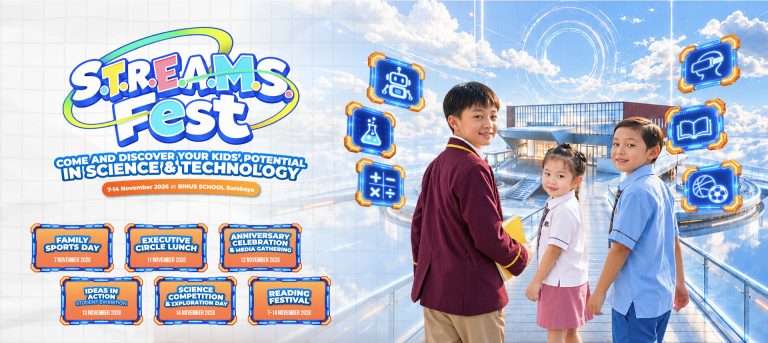
S.T.R.E.A.M.S. Fest 2026: Discover Your Kids’ Potential in Science & Technology
15 October 2026
As part of BINA NUSANTARA’s 45th anniversary and BINUS SCHOOL Surabaya’s anniversary, we’re excited to invite you and your family to celebrate with us at S.T.R.E.A.M.S. Fest 2026, happening from 7–14 November 2026!
S.T.R.E.A.M.S. Fest invites the community to discover how children can explore their potential through a variety of engaging activities in Science, Technology, Reading, Engineering, Arts, Mathematics, and Sports.
More than just a school event, S.T.R.E.A.M.S. Fest provides opportunities for students to showcase their ideas, challenge themselves, explore new interests, and experience learning beyond the classroom.
Throughout the week, visitors can look forward to a variety of exciting programmes, including:
1. Family Sports Day
Saturday, 7 November | 07:00 AM–01:00 PM
Multi-Purpose Hall, BINUS SCHOOL Surabaya
2. Community Gathering
Wednesday–Thursday, 11–12 November
3. Anniversary Celebration & Media Gathering
Thursday, 12 November | 10:00 AM–02:00 PM
BINUS SCHOOL Surabaya
4. S.T.R.E.A.M.S. Fest Assembly & "Ideas in Action" Student Exhibition
Thursday, 12 November | 08:00–12:00 Noon
Multi-Purpose Hall
5. Science Competition
Saturday, 14 November | 10:00 AM–03:00 PM
BINUS SCHOOL Surabaya
6. Exploration Day
Saturday, 14 November | 09:00 AM–12:00 PM
Open House, School Tour, Trial Class & On-Site Assessment
BINUS SCHOOL Surabaya
7. Reading Festival
7–14 November | BINUS SCHOOL Surabaya
Reading Buddies: Tuesday, 10 November | 08:00–08:40 AM
Book Brick Bonanza: 9–13 November | During library hours| Library
Student Bookfluencers: 10–20 November
Stories Without Borders: Friday, 20 November | Library
Early Years: 09:30–10:00 AM
Primary: 10:20–11:00 AM
Middle School: 11:00–11:40 AM
Book Character Parade: Friday, 20 November | 08:00–09:15 AM | Multi-Purpose Hall
Each activity reflects BINUS SCHOOL Surabaya’s commitment to creating meaningful learning experiences that help students develop not only academic knowledge, but also creativity, confidence, communication, collaboration, and problem-solving skills.
Through hands-on exploration, competitions, exhibitions, reading activities, sports, and community engagement, students are encouraged to become active learners who are ready to understand and respond to an increasingly dynamic world.
Discover, Explore, and Grow Together
S.T.R.E.A.M.S. Fest 2026 is also an opportunity for parents to experience the learning environment at BINUS SCHOOL Surabaya and see how students are encouraged to connect knowledge with real-life experiences.
BINUS SCHOOL Surabaya is committed to providing the best international learning environment in Surabaya, East Java, with a high quality curriculum and internationally qualified teachers, from Early Years through to the Secondary Programme. BINUS SCHOOL Surabaya empowers the future with digital excellence, personalised learning experiences, and a strong focus on student wellbeing.
BINUS SCHOOL Surabaya is an IB World School, authorised to offer the Primary Years Programme (PYP), and is currently a Candidate School for the Diploma Programme (DP) and Career-related Programme (CP).*
*Candidate status for the Diploma Programme and Career-related Programme gives no guarantee that authorization will be granted. Only schools authorized by the IB Organization can offer the IB programmes. For further information about the IB and its programmes, visit www.ibo.org.